Estimated Reading Time: 5 Minutes
- Silencers are legal to own for most Americans.
- There are a few basic criteria for suppressor ownership.
- You can share your silencers with friends and family in most cases, but there are stipulations.
- Prohibited Persons cannot possess NFA items.
Few things are more fun than plinking with a .22lr and a silencer or shooting long-range targets and hearing the steel ring louder than your gunshot.
Shooting is also more fun with friends! Most of us have a group we can text on a Saturday morning to hit the range or coordinate a weekend hunt.
In these situations, it is essential to be aware of who can and cannot use your silencers and other NFA items to ensure you’re not violating any gun laws while shooting with your NFA weapons.
Table of Contents
Who is Legally Allowed to Use a Suppressor?
Most adults in America can legally own suppressors.
Silencers are legal in 42 states, and millions of law-abiding gun owners currently own and use silencers.
If you can legally purchase a firearm, there is a good chance that you can also purchase a suppressor. The basic requirements to legally buy a silencer are:
- You must be at least 21 years old.
- You must live in a state that allows possession.
- You must not have any felony convictions or otherwise be a “prohibited person.”
There are also instances where people other than you (the original purchaser of the suppressor) can use or possess the silencer with varying degrees of freedom. The filing method you chose when you submitted your ATF Form 4 dictates who else can use your suppressor.
How your chosen filing method impacts who can use your suppressor:
Individual
If you filed your suppressor application as an individual, you cannot lend your suppressor to anyone who is not physically present and under your direct supervision.
Single Shot Trust / Single Shot Unlimited Trusts
If you’re using a Silencer Shop Single Shot Trust or our Single Shot Unlimited Trust, you can use an addendum to add trustees.
The trustees, or responsible persons, you permit can access and possess the NFA items the trust owns - so long as they are not otherwise legally prohibited.
Traditional NFA Trust
When using a Silencer Shop Traditional NFA trust, your trustees listed will be allowed to use the silencers or other NFA items on the trust, just like with Single Shot trusts.
Corporation
If you filed your suppressor application as a corporation, officers and bona fide employees of that corporation are allowed to use the silencer for the corporation’s business purposes (as opposed to personal use).
You’ll need to be mindful of the distinction between true employees and independent contractors, and you’ll need to ensure your corporate entity complies with other applicable laws to maintain its corporate existence.
You may need to consult legal counsel to ensure your corporation is created and maintained correctly.

Who Cannot Use My Suppressor?
There are disqualifiers that prohibit a person from using or possessing NFA items.
The Gun Control Act (GCA) classifies these individuals as “Prohibited Persons.”
A prohibited person, pursuant to the GCA, includes anyone who:
- Is under indictment for or convicted in any court of a crime punishable by imprisonment for a term exceeding one year;
- Is a fugitive from justice;
- Is an unlawful user of or addicted to any controlled substance (as defined in section 102 of the Controlled Substances Act, codified at 21 U.S.C. § 802);
- Has been adjudicated as a mental defective or has been committed to any mental institution;
- Is an illegal alien;
- Has been discharged from the Armed Forces under dishonorable conditions;
- Has renounced his or her United States citizenship;
- Is subject to a court order restraining the person from harassing, stalking, or threatening an intimate partner or child of the intimate partner; or
- Has been convicted of a misdemeanor crime of domestic violence.
Note: Some of these categories are currently being challenged in the courts as unconstitutional, but ATF still enforces them.
State Laws Regarding Suppressors
The legal landscape for suppressor use varies across the United States.
Some states welcome them with open arms, while others impose restrictions or outright bans.
Silencer Shop is currently funding litigation in Illinois and elsewhere to challenge these bans.
We strongly encourage you to support organizations such as the American Suppressor Association (ASA) and the Second Amendment Foundation (SAF) who join Silencer Shop in this fight.
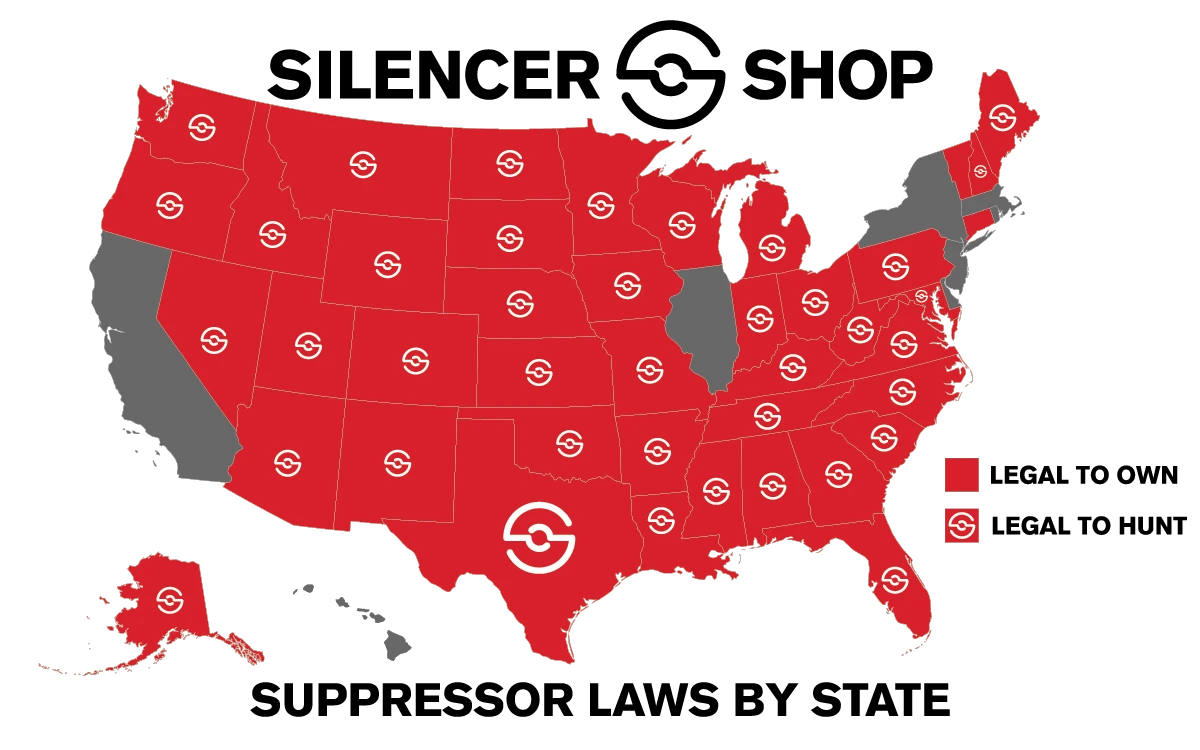
Friendly States
Silencers are legal in 42 states across the country. You can likely own a suppressor if you reside in the following states.
| AL | AK | AZ | AR | CO | CT | FL |
| GA | ID | IN | IA | KS | KY | LA |
| ME | MD | MI | MN | MS | MO | MT |
| NE | NV | NH | NM | NC | ND | OH |
| OK | OR | PA | SC | SD | TN | TX |
| UT | VT | VA | WA | WV | WI | WY |
Note: Even if your state is on this list, be sure that your local laws allow for silencer ownership.
Middle Ground States
41 of the 42 states above also allow suppressors while hunting.
The one stand-out state that allows silencer ownership but prohibits hunting with silencers is Connecticut.
No-go Zones
The usual suspects: California, Delaware, Hawaii, Illinois, Massachusetts, New Jersey, New York, Rhode Island, and Washington D.C. outright ban the ownership and use of silencers.
Certain states, such as Washington, allow possession of silencers but prohibit their use with certain weapons through so-called “assault weapon” statutes.
Suppressor Usage FAQ’s
Can your spouse use your suppressor?
Assuming your spouse is not a prohibited person, they can use and possess the suppressor if they are a trustee of the trust the suppressor belongs to or a bona fide employee of the corporation that owns the suppressor.
If they do not qualify as a trustee or a bona fide employee, they may still use and possess the item in your presence and under your direct supervision (the suppressor must remain under your control).
These same rules apply in your home, make sure that NFA items are properly stored to avoid violations.
Do I have to carry my tax stamp with my suppressor?
Federal regulations require you always to keep a copy of the approved Form 4 or other registration documents with the device.
Your approved tax stamp does not need to be a physical copy; a PDF copy of the approved Form 4 saved to your phone or a printed copy will suffice.
Conclusion
Shooting suppressed is just plain fun, and sharing that enjoyment with your friends and family makes NFA item ownership even better.
The easiest way to share your silencers with others is to make them trustees of the gun trust that holds your suppressor.
If you filed as an individual, that’s okay too; others could still use your items but must be accompanied by you and be under your direct supervision.
As always, double-check with your local laws and regulations to ensure you remain compliant when using your NFA items.