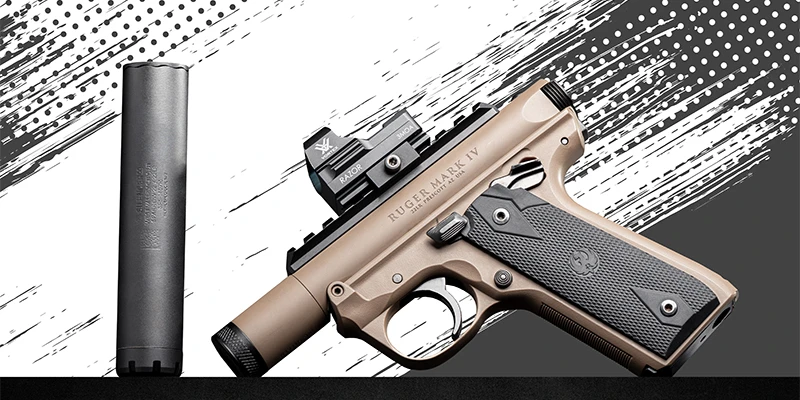
What Is a Rimfire Suppressor?
A rimfire suppressor is a can built for .22 LR and the other small rimfire cartridges, and it differs from every other suppressor category in one important way: it comes apart. Rimfire ammunition uses unjacketed lead bullets and dirty powder, so the baffles fill with lead and carbon fast. Rimfire cans are designed to be disassembled and cleaned, which centerfire cans are not. They are also the least expensive suppressors you can buy, the lightest, and by a wide margin the ones people shoot the most. We carry rimfire suppressors from SilencerCo, Dead Air, Rugged, Q, CGS, Thunder Beast and every other major manufacturer.
Which Calibers Does a Rimfire Suppressor Cover?
Most rimfire cans are rated for the full family of .22 rimfire cartridges, which means one suppressor typically covers .22 LR, .22 Short, .22 WMR and .17 HMR. Many are also rated for 5.7x28. Check the rating on the specific model, because the magnum rimfire rounds run at meaningfully higher pressure than standard .22 LR and not every can is built for them.
What a rimfire suppressor will not do is handle centerfire. A .22 LR can and a .223 rifle share a bullet diameter but nothing else, and putting a centerfire round through a rimfire suppressor will destroy it, usually violently. If you want one can for a .22 and an AR, you are shopping for a centerfire rifle can (/silencers/rifle-suppressors/5-56mm.html) that is separately rated down for rimfire use, not a rimfire can rated up.
Why Do Rimfire Suppressors Come Apart?
Because .22 LR is filthy, and a rimfire can that cannot be cleaned eventually becomes a solid piece of lead. Unjacketed lead bullets shed material on their way through, and rimfire powder leaves heavy carbon behind. A user-serviceable rimfire can disassembles so you can strip the baffles, clean them, and put it back together. That is the defining feature of the category and the thing worth checking before you buy.
How often depends entirely on how much you shoot. A few hundred rounds between cleanings is a reasonable habit for most shooters. If you let it go long enough, the baffle stack can seize together, and freeing it is a bad afternoon. Buying a fully user-serviceable design is how you avoid the whole problem.
How Do You Choose a Rimfire Suppressor?
Start with how easy it is to clean, because that is the thing you will interact with most. A fully user-serviceable design with a baffle stack that pulls out as a unit is worth more day to day than small differences in sound performance.
Then think about where it is going to live. If it spends its life on a 10/22, buy for sound and do not worry about length. If it is going on a .22 pistol, weight and balance out front matter a lot, and a short configuration or a titanium build makes the gun feel like itself again.
Then check the caliber rating against what you actually own. If there is a .17 HMR or a .22 Magnum in the safe, buy a can rated for them now rather than buying a second one later. And keep the ammunition in mind: standard-velocity .22 LR is subsonic out of most barrels, which is why suppressed rimfire is as quiet as it is. High-velocity .22 crosses the sound barrier and gives back much of what the can does for you.
Rimfire Suppressor Questions, Answered
How much does a .22 suppressor cost?
Rimfire cans are the least expensive suppressors on the market, with most of the category falling roughly between $250 and $600. The $200 federal tax stamp that used to sit on top of that is now $0, and we include it on every suppressor we sell, which changed the entry price for this category more than any other.
Do you have to clean a rimfire suppressor?
Yes, and that is why they are built to come apart. Lead and carbon from unjacketed .22 ammunition builds up in the baffles, and left long enough it can lock the stack together. Most shooters clean every few hundred rounds. Centerfire cans, by contrast, are sealed and are not user-serviceable.
Can you shoot .22 Magnum through a .22 LR suppressor?
Only if the can is rated for it. .22 WMR and .17 HMR run at much higher pressure than standard .22 LR, and not every rimfire suppressor is built for them. The rating is listed on each product page, and several of the cans on this page cover the full rimfire family.
Is a suppressed .22 actually quiet?
Suppressed .22 LR with standard-velocity ammunition is the quietest common shooting experience there is, and it is what most people picture when they imagine a suppressor. Switch to high-velocity ammunition and the bullet goes supersonic, which adds a crack the suppressor cannot do anything about. Ammunition choice matters more on rimfire than on any other caliber.
Can a rimfire suppressor be used on a centerfire rifle?
No. Never put a centerfire round through a rimfire can. The two are not built for the same pressures and the suppressor will fail. Some centerfire rifle cans are rated down for occasional rimfire use, which is the only version of this that works, and even then a dedicated rimfire can is easier to live with because it cleans.
Does a rimfire suppressor work on a pistol and a rifle?
Yes, as long as the threads match. The same .22 can commonly runs on a 10/22 and a .22 pistol, and modular designs let you shorten it for the pistol. Check the thread pitch on each host, since 1/2x28 is common but not universal on rimfire barrels.
What thread pitch do .22 barrels use?
1/2x28 is the most common on threaded rimfire barrels in the U.S., though some rifles and pistols use other pitches and some barrels are not threaded at all. Confirm before ordering, and if your host is not threaded, a gunsmith can usually handle it.
Keep exploring