Quick Detach vs Direct Thread Suppressor: How to Choose
There are a lot of suppressor mounting systems on the market today, and the right one depends entirely on how you shoot, what you shoot, and how often you swap cans between different guns. Two systems sit at the center of the conversation:
- Quick detach suppressors (QD)
- Direct thread suppressors (DT)
QD mounts let you take a suppressor on and off in seconds and move it quickly between rifles, even with different thread pitches. Direct thread mounts skip the adapter entirely, screwing the suppressor straight onto your barrel for less weight, less length, and a lower price tag. Both work. The one that fits you depends on the trade-offs below.
Table of Contents
Quick Detach Suppressor
Quick detach, or QD suppressor mounts let you install or remove your suppressor from your gun in a few seconds. These systems have two parts: a muzzle device (usually a muzzle brake or flash hider) and the QD adapter that interfaces with the base of the suppressor.
The muzzle device installs on your barrel. The adapter installs into the rear of the suppressor. On some modern cans, the QD adapter is built in from the factory. Examples include:

Benefits of a Quick Detach Suppressor
QD systems get the suppressor on and off faster than threading it on by hand, but speed is only one of the upsides. The bigger story is versatility.
Swapping Between Hosts
QD systems let you move one suppressor between rifles with different thread pitches without changing the can. Common AR-15 barrels run 1/2x28; a .300 BLK might be 5/8x24. With QD, you mount the appropriate muzzle device on each rifle, leave it there, and slide the suppressor over to whichever rifle you’re running that day.
Muzzle Device Stays Put
When the suppressor comes off, you still have a useful muzzle device on the rifle. A muzzle brake helps with recoil for unsuppressed practice. A flash hider keeps your low-light signature down. Direct thread doesn’t give you that, since pulling the suppressor leaves bare threads.
Secure Lock Up and POI Repeatability
Most modern QD mounts lock the suppressor in place with a taper, ratcheting collar, or detent. Properly torqued, they don’t come loose under sustained fire. The best designs also give you excellent point-of-aim repeatability, meaning the rifle’s zero barely shifts when the can comes off and goes back on.
Cons of a Quick Detach Suppressor
QD isn’t free, and the trade-offs are real:
- Higher upfront cost. You’re paying for the suppressor, the QD muzzle device (often $100-$200), and sometimes a separate adapter.
- More weight and length. The muzzle device sits between the barrel and the suppressor, adding roughly a half-inch and a few ounces over a direct thread setup.
- Carbon buildup in the interface. The muzzle device end gets caked in carbon after extended shooting. Periodic cleaning keeps lock-up consistent.
- POI shift on cheaper or out-of-spec mounts. Quality designs hold zero. Budget systems and worn taper interfaces can drift a quarter to half MOA between removals. Stick to reputable brands, like the ones we carry at Silencer Shop.
- One more part to track. More parts means more potential out-of-spec stacking, though modern machining keeps this rare.
Different Types of Suppressor Mounts
“QD” isn’t one thing. It’s an umbrella for several mount families, and the right one depends on the suppressor brand, the host platform, and how the system locks up. Here are the major categories you’ll see in 2026:
- HUB (Hybrid Universal Base). A standardized 1.375x24 rear thread pitch that nearly every modern centerfire suppressor uses. HUB itself isn’t a mount style. It’s the interface that lets you bolt almost any modern QD or direct-thread mount onto the same can. For the full breakdown see our HUB Mount guide.
- Taper-lock systems. Designs like the Q Plan B, Dead Air KeyMo, Dead Air Xeno, and the various SilencerCo Bravo and Charlie ASR mounts use a precision-machined taper to seal the can against the muzzle device. Strong lock-up, repeatable POI, simple to service.
- Quick-action collar systems. SureFire Fast Attach and similar designs use a rotating collar that engages or releases the can with a partial turn. Fast, secure, and very popular on suppressors.
- Tri-lug. Three lugs on a pistol-caliber muzzle device that the suppressor twists onto with a quarter-turn. Standard on submachine guns, pistol-caliber carbines, and 9mm rifle setups. The YHM HD 3-Lug Adapter is a common example.
Direct Thread Suppressor
Direct thread, or DT, suppressors keep it simple. The suppressor threads straight onto the muzzle of your barrel, with no muzzle device, no adapter, and no extra parts. As long as your barrel is threaded to a pattern the suppressor (or its mount) accepts, you’re good.
For example, if your 5.56 AR-15 barrel is 1/2x28, a 1/2x28 direct thread mount will spin right on. HUB-compatible suppressors accept a wide range of direct thread adapters so you can run one can across multiple thread pitches as long as the caliber is compatible.
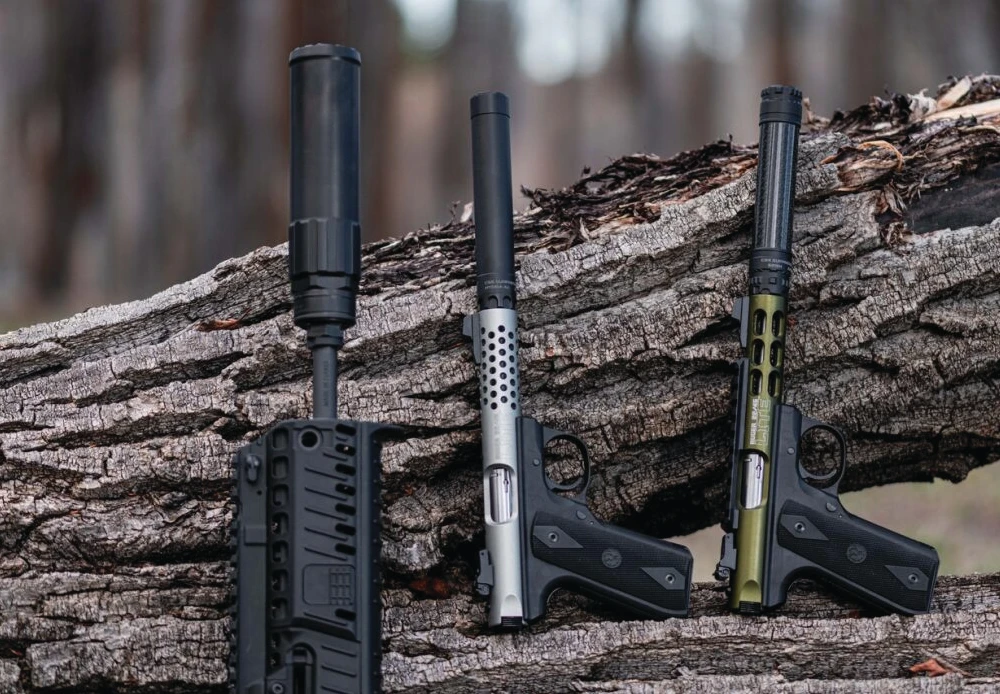
Some suppressors are sold with direct thread baked into the rear, including:
Benefits of a Direct Thread Silencer
There are real reasons to skip the QD adapter and run direct thread. Cost, simplicity, weight savings, and tighter tolerance stacking are the headline upsides.
Cost Savings
Direct thread usually saves you money over a QD setup. Most HUB-compatible suppressors ship with a direct thread mount in the box, and replacement DT mounts in alternate thread pitches are cheap. There’s no separate muzzle device to buy.
Easy Attachment
Direct thread is about as simple as it gets. Match the barrel threads to the mount pitch and screw it on snug. If your AR barrel is 1/2x28, a 1/2x28 mount will work. Done.
Lighter and Shorter
Skipping the muzzle device cuts about a half-inch of length and a few ounces of weight off the overall package. For a hunting rifle or a precision setup where balance matters, that adds up.
Tighter Tolerance Stacking
Fewer parts means fewer interfaces, which means fewer opportunities for out-of-spec components to introduce a problem. Modern machining keeps tolerance stacking issues rare on QD systems too, but if you want the shortest possible path between bore and baffle, direct thread is it.
Cons of a Direct Thread Suppressor
Direct thread isn’t all upside. The trade-offs worth knowing:
- Slow to install and remove. Threading a suppressor on by hand takes 15-20 seconds and a positive check that it’s snug. If you swap between hosts often, that gets old fast.
- Locked to one thread pitch (per mount). A 1/2x28 direct thread mount works on 1/2x28 barrels. To run the same can on a 5/8x24 barrel you’ll need a second mount.
- Carbon locking. Heat and carbon between the barrel threads and the suppressor mount can almost fuse the joint over time. Cleaning the threads regularly prevents it. A thoroughly carbon-locked suppressor sometimes requires shop tools to break free.
- No muzzle device benefit when the can comes off. Pulling the suppressor leaves bare threads, not a brake or hider. A thread protector cap is a must-have.
Is a Direct Thread Suppressor More Accurate?
In theory, yes, slightly. Both systems can deliver excellent accuracy, but a direct thread suppressor has one fewer interface between the bore and the suppressor body, which means one fewer source of potential misalignment.
In practice, the difference is small enough that a well-built QD setup from a reputable brand will shoot inside what most rifles can resolve. Precision shooters are running both QD and DT suppressors and winning national matches, it comes down to your preference.
Which Should You Choose
If you own one or two rifles in a single thread pitch and you keep the suppressor on the gun most of the time, direct thread is the simpler, cheaper, lighter option. Hunters running a dedicated suppressed setup and precision shooters wanting the tightest tolerance both lean this direction.
If you own multiple rifles, shoot suppressed regularly across calibers, or want the ability to drop the can in under 10 seconds, QD pays for itself. Tactical-style shooters, multi-gun competitors, and anyone running a single suppressor across an AR-15, .300 BLK, and a precision rifle should plan around a QD system.
If you’re not sure yet, buy a HUB-compatible suppressor. The 1.375x24 rear thread lets you start with the direct thread mount in the box and add a QD interface later if your use case changes. Browse HUB-compatible mount systems to see the range.
Conclusion
The mounting system on your suppressor sets how fast it comes on and off, how much weight and length the can adds, what it costs, and how it locks up under sustained fire. QD systems give you swap-ability across hosts and a useful muzzle device when the can is off. Direct thread saves money, weight, and length, and shaves a fraction off potential alignment stack. Most modern HUB-compatible suppressors let you run either, which is the right way to keep your options open.
If you want help picking the right mount for your gun, our team is at 512-931-4556 or support@silencershop.com. New to the process entirely? Start with how to buy a suppressor.
Frequently Asked Questions
What is the difference between a direct thread and a QD suppressor?
A direct thread suppressor screws straight onto your barrel’s muzzle threads. A QD suppressor uses a two-part system: a muzzle device attached to the barrel and an adapter on the suppressor that locks the two together. Direct thread is simpler and lighter. QD is faster to remove and easier to move between hosts.
Is a direct thread suppressor more accurate than a QD?
Slightly, in theory. A direct thread interface has one fewer point of potential misalignment. In practice, a quality QD mount from a reputable manufacturer delivers accuracy indistinguishable from direct thread.
Are direct thread suppressors better than QD?
Neither is universally better. Direct thread is better for single-host setups, weight-sensitive builds, and budget-conscious buyers. QD is better for multi-host shooters, tactical use, and anyone who removes the can frequently. The right answer depends on how often you swap and how many hosts the suppressor needs to serve.
Can a direct thread suppressor come loose while shooting?
Yes, under sustained fire the rotational forces from firing can gradually unthread a direct thread suppressor. Long strings of fire call for a torque check every couple of magazines. QD mounts with a positive lock-up don’t have this issue. That said, we’ve shot plenty of machine guns with direct threaded suppressors and haven’t had them walk off. Just install them properly and you’re good to go.
What thread pitch is most common for direct thread suppressors?
1/2x28 for 5.56 and most 9mm setups, 5/8x24 for .30 caliber rifles. There are dozens of other thread pitches across calibers and platforms. Direct thread mounts are usually sold in the major patterns, and HUB-compatible suppressors accept interchangeable thread pitch adapters.
What is a HUB-compatible suppressor?
HUB stands for Hybrid Universal Base. It’s an industry-standardized 1.375x24 thread pitch on the rear of the suppressor that accepts a wide range of mounts from different manufacturers. A HUB-compatible suppressor can typically run direct thread, QD, ASR-pattern, taper-lock, or tri-lug interfaces, depending on which mount you screw into the back.
Do QD suppressors come loose?
Not when they’re seated and torqued correctly. Modern QD designs use locking tapers, ratcheting collars, or spring-loaded detents that resist rotational force from firing. Carbon buildup at the interface can affect lock-up over time, so periodic cleaning is part of QD ownership.
Is direct thread quieter than QD?
Mounting type can affect sound performance. Direct thread mounts usually allow for more volume inside the suppressor, as a muzzle device isn’t taking up any additional space, and can produce slightly better results. However, there are exceptions, and some suppressors are designed specifically for certain muzzle devices.
Can you convert a direct thread suppressor to QD?
If the suppressor is HUB-compatible, yes. You replace the direct thread mount with a QD mount that threads into the same 1.375x24 rear. If the suppressor has a fixed, non-removable direct thread interface (as with some rimfire and dedicated suppressors), conversion is not possible.