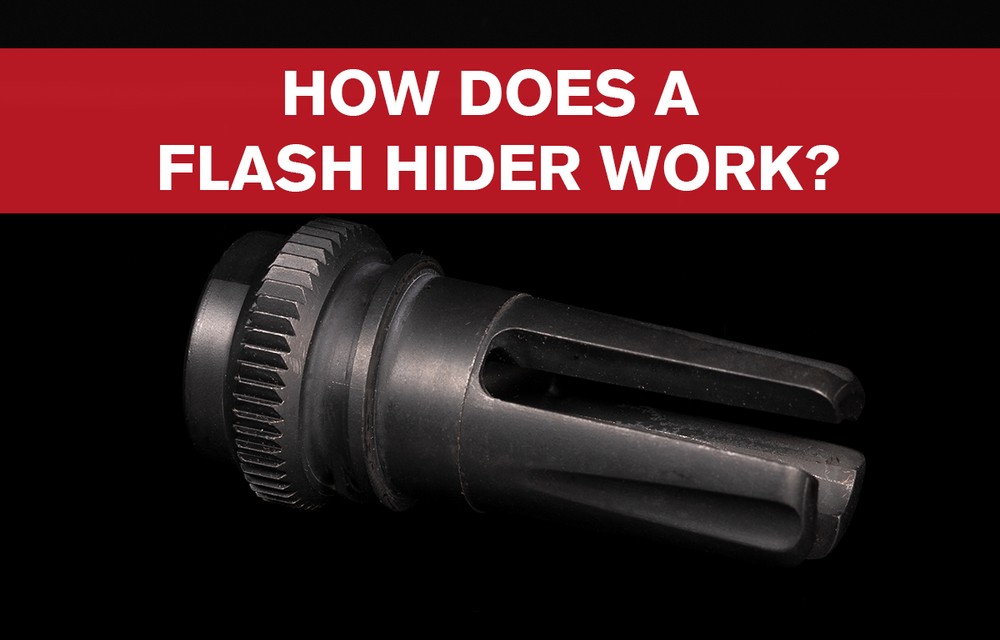
It's time to wrap up our blog series on the most popular types of muzzle devices by discussing what is a flash hider and how does a flash hider work? We've covered muzzle brakes and compensators, now we'll dive into the pros and cons of flash hiders (also known as flash suppressors) and share some flash hider examples in popular calibers. There is a lot to cover here, so let's jump in.
What is a flash hider?
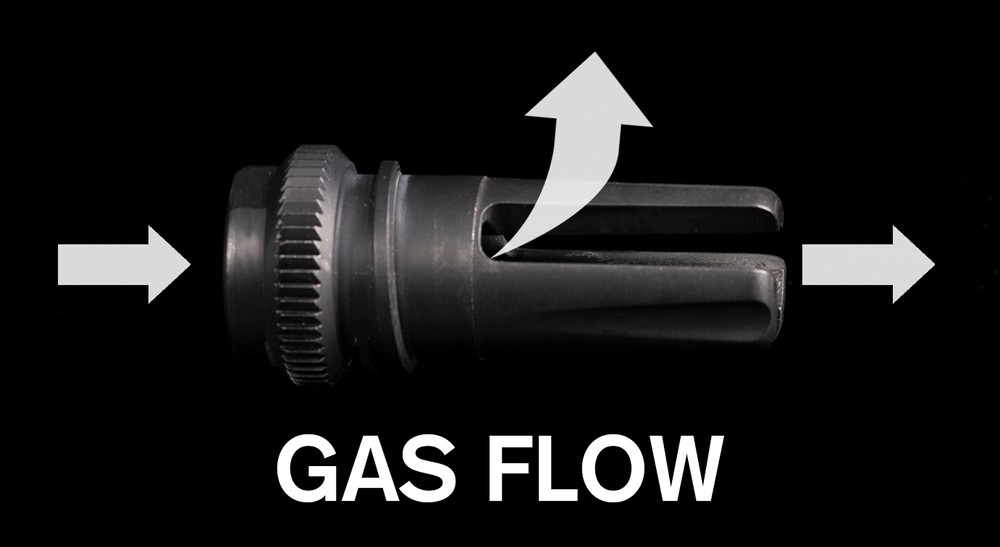
A flash hider (aka flash suppressor) is a muzzle device engineered to reduce the visible ignition of unburned powder and hot gases exiting the barrel. It accomplishes this by breaking the gas column into smaller jets and increasing mixing with ambient air so the combustion is less visually intense.
Who are we hiding the flash from? Primarily the shooter — flash hiders do a good job of protecting a shooter's vision in low light or no light, when a bright muzzle flash can ruin your natural "night vision."
How Flash Hiders Reduce Muzzle Flash
Simply put, flash hiders work by breaking up the unspent gunpowder and gases expelled when a projectile exits the barrel, thereby reducing the amount of combustion occurring outside the barrel. Whereas other muzzle devices channel these gases in certain directions to reduce recoil or muzzle flip, flash hiders are designed to protect your vision.
Flash hiders are manufactured in all different shapes and sizes. Generally they have three or four evenly spaced prongs and can either be open- or closed- tine systems. The A2 birdcage is a very common example of a closed-tine flash hider. Open-tine flash hiders can provide even more variety because the lengths of the prongs can either be the same or different. Sometimes open-tine flash hiders that have the same length prongs can produce a “tuning fork” effect. Having variable length prongs can mitigate that effect.
- Gas diffusion: prongs/slots create multiple smaller gas jets that cool and mix faster.
- Temperature drop: smaller jets reduce peak gas temperatures so fewer photons are produced.
- Resonance avoidance: some designs vary prong length to avoid “tuning-fork” resonance which can create flash irregularities.
- Design trade-offs: open prong designs trade sacrificial protection and some debris vulnerability for quicker mixing; closed designs (A2/birdcage) contain the gas column more.
Flash Hider Types & Common Examples
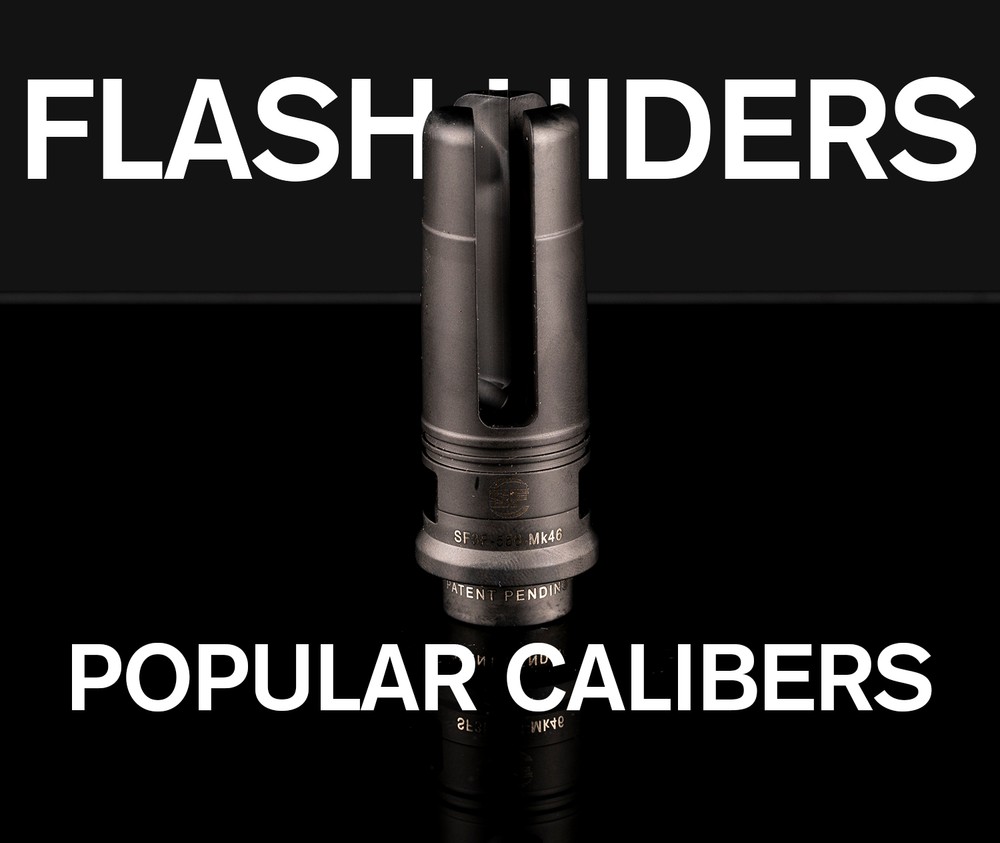
What are some good flash hider examples in popular calibers? We’re glad you asked! While we’re giving you examples, it’s important to note that some flash hiders can be used with a different manufacturer’s suppressor - but always be sure to check before you try mounting a suppressor on. Ok, now let’s discuss a few notable choices:
- Pronged / open-tine: best for simple flash dispersal; quick to install.
- Closed-tine (A2 / birdcage): robust, widely compatible, often used on military-style barrels.
- Hybrid devices: modern designs that combine features of flash hiders and compensators for dual performance.
9mm flash hiders
The SilencerCo ASR Flash Hider is a great option for use with any ASR mount. This SilencerCo flash hider comes in various thread pitches and calibers, but we’re giving it time to shine with its 9mm flash hider. With three prongs of different length, the ASR flash hider is very effective and reduces the tuning fork effect that is common with flash hiders.
AR 15 flash hider (5.56 and 7.62 flash hiders)
Now it’s time to discuss a few AR 15 flash hider examples that have different aesthetics so you can see how much they can vary.
- The OSS Flash Hider QD is an effective option and great example, compatible with the full line of OSS's Helix quick-detach suppressors.
- The SureFire WARCOMP Closed Tine flash hider is a hybrid device designed to also reduce muzzle rise in addition to muzzle flash. It's a strong mounting option for SOCOM Series Fast-Attach suppressors.
- The Dead Air Flash Hider is another great option for 5.56 and 7.62 calibers, and is compatible with the popular Sandman-S, Sandman-K and Sandman-L suppressors.
- Lastly, the YHM .30 Caliber Phantom Flash Hider is yet another example of a well-engineered flash hider providing a unique look. This YHM flash hider is designed to prevent and reduce carbon buildup inside compatible suppressors, such as the .30 Cal. Phantom Q.D. Sound Suppressor.
When & Why Shooters Use Flash Hiders
Primary use-cases: low-light shooting, hunting, tactical operations, and anytime preserving shooter night vision is critical. Flash hiders also reduce the short-range visual signature which matters in low-light or close-quarters environments
Benefits
- Less flash. If this bothers you when shooting, here's your solution.
- More effective low-light or no-light shooting.
- No timing! Other muzzle devices need to be threaded to the right orientation — a process that can take time. Flash hider installation is a much simpler process.
- Flash hiders vary in appearance, but they share one thing: strong aesthetics.
Flash Hiders & Suppressors — Compatibility and Best Practices
Do people use flash hiders with their suppressors? They sure do. One huge benefit of using a flash hider instead of muzzle brakes and some compensators is the fact that it doesn’t have to be timed. As you may already know, it takes time to time, and some people just don’t want to deal with that.
While the amount of protection is up for debate, there is one common agreement: unlike their brake and compensator brethren, flash hiders do not serve as a sacrificial baffle because of how they’re constructed. Another notable mention is that by diffusing and muzzling gases, a good suppressor accomplishes the same goal as a flash hider: flash reduction.
- Thread pitch check: confirm barrel thread (e.g., 1/2x28, 5/8x24, 1.375x24 HUB) before purchase.
- Mount system: verify whether your suppressor mounts to ASR, KeyMo, HUB, or direct-thread. Not all flash hiders are designed to be used as a suppressor mount.
- Timing: most pure flash hiders do not require timed orientation; however, if a flash hider doubles as a mounting base or compensator, follow OEM timing instructions.
- Safety note: never force a suppressor onto an incompatible muzzle device — verify compatibility with the product's description.
Installation, Timing & Point-of-Impact (POI) Notes
- Torque to spec: always install flash hiders to manufacturer torque recommendations (use a torque wrench if provided).
- Indexing: if the device must be timed, use shims or crush washers per OEM guidance.
- POI checks: re-zero or verify POI after installing or removing muzzle devices — small shifts can occur, especially with timed devices.
Maintenance & Troubleshooting
- Routine: inspect after each range day; deep clean every ~500 rounds.
- Cleaning: use X solvent + nylon brush for ports and a non-abrasive cloth for threads. Avoid steel brushes on soft finishes.
- Carbon lock: soak with penetrating solvent; apply steady torque to remove. If stuck, consult a gunsmith.
- Anti-seize: apply thin film of manufacturer-approved anti-seize and torque to spec on re-installation.
Quick Reference
- Flash hiders reduce visible muzzle flash by dispersing and cooling exiting gases.
- They protect night vision and reduce visual signature.
- They are not recoil brakes — if recoil control is required, use a muzzle brake/compensator or combined device where appropriate.
- Verify thread pitch and mount compatibility before mixing devices and suppressors.
Frequently Asked Questions About Flash Hiders
Q: What does a flash hider do?
A: It breaks up and cools combustion gases leaving the barrel so the muzzle flash is reduced and shooter night vision preserved.
Q: Does a flash hider reduce recoil?
A: No — flash hiders are designed for signature reduction; muzzle brakes handle recoil reduction.
Q: Can I use a flash hider with a suppressor?
A: Often yes — if the flash hider is compatible with your suppressor’s mounting system (check thread pitch and OEM compatibility).
Q: Will a flash hider change my point of impact?
A: It can, especially if the device requires timing or if threads/torque differ — always verify POI after installation.
Q: How do I remove a stuck flash hider?
A: Apply penetrating oil, allow time to soak, and use steady torque; if unsure, have a gunsmith handle it.
Q: Is an A2 flash hider legal in my state?
A: Laws vary—some states restrict devices defined as “flash suppressors.” Verify local law and product compliance.
Q: How often should I clean my flash hider?
A: Inspect each use; deep clean every ~500 rounds or sooner with heavy use.
Q: What’s the best flash hider for AR-15?
A: Depends on host and mount system; consider manufacturer-recommended devices for ASR/KeyMo/HUB or universal closed-tine models for direct-thread hosts.