Pistol caliber suppressors are some of the most versatile cans in any safe. The same suppressor can run on a 9mm carbine, a tilt-barrel pistol, and .357 lever action. The catch is that mounting one to a pistol means understanding three small but critical components: the recoil booster (also called a Nielsen device), the piston, and the fixed barrel spacer. This guide walks through what each piece does and how to mount a pistol suppressor on tilt-barrel and fixed-barrel handguns.
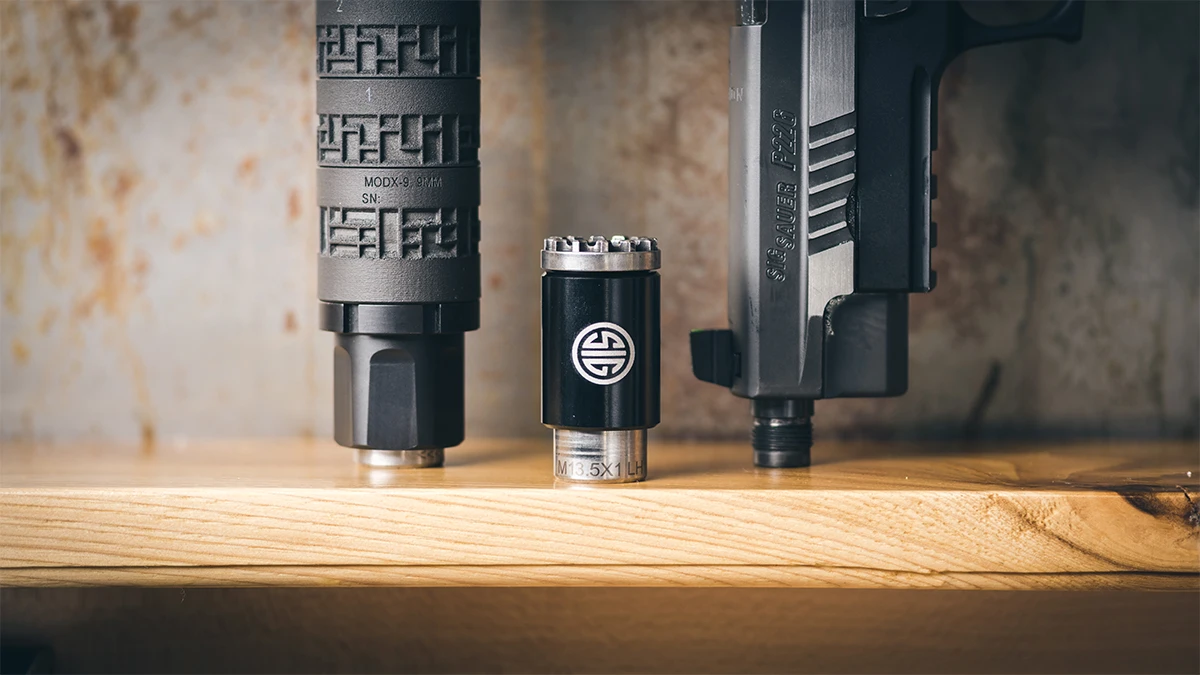
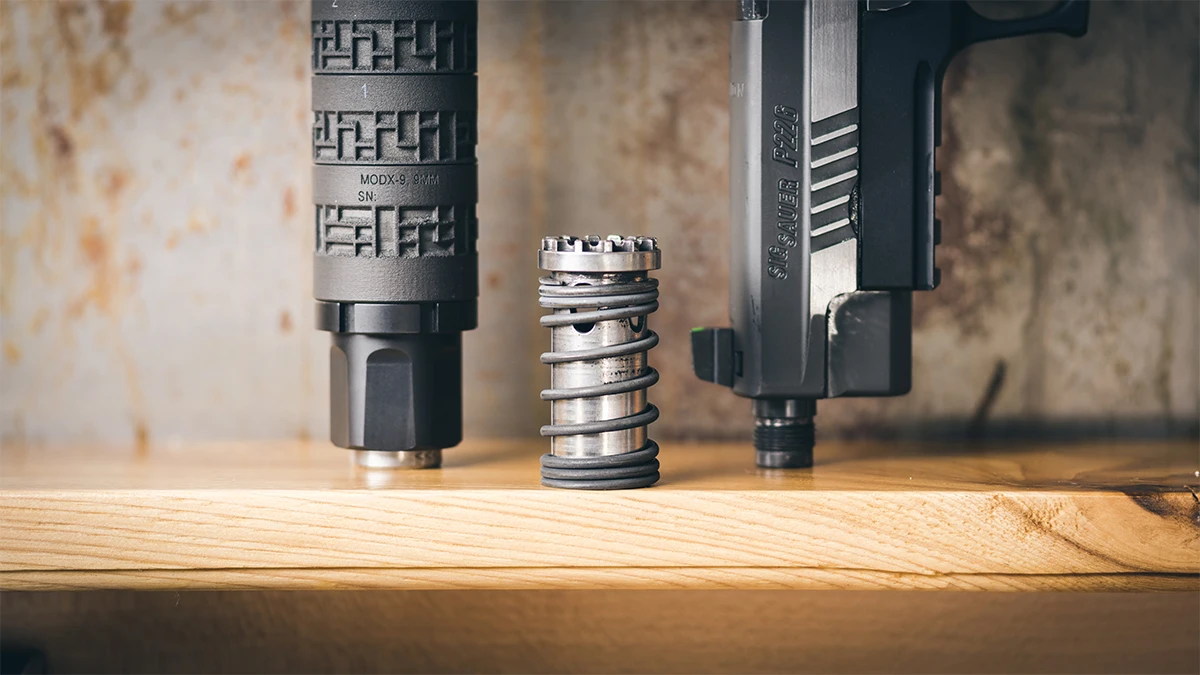
For the purpose of this article, we’ll be using a Sig Sauer ModX-9 and the fixed barrel spacer and piston it ships with. Other models and brands work the same way, so you can apply everything here to whatever your setup is.
Pistol Caliber Suppressor Parts
A pistol caliber suppressor has three components:
- The actual suppressor tube and internal baffles. The actual suppression work happens here.
- The recoil booster (Nielsen Device). Mounted on the rear of the suppressor, on the side that connects to the firearm.
- A piston. Sits inside the recoil booster and provides the threads that attach the suppressor to the barrel.
The reason pistol caliber suppressors are different from rifle suppressors is that pistols use a Browning-tilt-barrel-action, which means as the barrel slide rearward the barrel tilts upward during the cycle. A recoil booster lets the suppressor cycle reliably on tilt-barrel pistols by storing and releasing energy during that movement. Tilt-barrel handguns include Glocks, Springfield XDs, Smith & Wesson M&Ps, Sigs— most modern handguns fall in this category.
Fixed Barrels and Fixed Barrel Spacers
There are some pistols that use a fixed barrel, but they are very uncommon. Pistols with fixed barrels, like the Laugo Alien or certain older HK models, don’t need a recoil booster because the barrel doesn’t move. For these hosts, there are two paths:
- Fixed barrel spacer. Replaces the booster spring with a solid spacer, which essentially disables the recoil booster. Pop the spring out, drop the spacer in, re-insert the piston, and you’re done.
- Fixed-barrel-only suppressors. Some pistol suppressors are built without a recoil booster at all. These work great on PCCs but won’t cycle reliably on a tilt-barrel pistol.
How to Mount a Pistol Suppressor
Before you mount the suppressor, check whether your barrel tilts. Lock the slide back. If the barrel angles as it travels rearward, your pistol uses a tilt-barrel system and you’ll need a working recoil booster. If the barrel stays fixed in place, you’ll need a fixed barrel spacer or a fixed-barrel-style suppressor.
Mounting steps:
- Confirm thread pitch. The piston’s threads have to match your barrel’s threads. Common pitches: 1/2x28 for 9mm setups; 13.5mmx1 LH (metric) is common for European 9mm threads; .578x28 for .45 ACP. Check the barrel’s published spec or the markings on the threaded section before buying anything.
- Install the correct piston in the booster. Hand-tight is usually enough. If your suppressor came with a torque spec, follow it.
- Apply a light coat of lubricant to the piston. White lithium grease is the standard recommendation because it tolerates the heat at the muzzle without breaking down. A thin coat keeps the piston and booster moving freely.
- Thread the suppressor onto the barrel. Hand-tight, then check for square seating. Don’t crank with pliers; finger torque is what you want.
- Cycle the action once or twice empty before live-fire. Confirm the slide returns fully into battery. If it doesn’t, the most common culprit is insufficient piston lubrication or a worn booster spring.
Swapping the Piston Between Hosts
One of the biggest advantages of a pistol caliber suppressor is that you can run it on multiple firearms with different thread pitches as long as you have the right piston for each. Pistons are inexpensive (typically $40-90 depending on brand), thread out and in quickly, and let one can serve a 9mm pistol, a .45 ACP, and a 9mm PCC if you collect all three pistons.
You can also use smaller-caliber pistons on larger-caliber suppressors. A .45 ACP suppressor like the Sig Sauer ModX-45 can run on a 9mm pistol with the right 9mm piston, or on a .40 S&W pistol with the .40 piston. The only hard rule: confirm the suppressor is rated for the pressure of the caliber you’re feeding it.
Threaded Barrels
You can’t mount any pistol suppressor without a threaded barrel. If you’re buying a new pistol, factory threaded barrels are common on M&P, Glock, Sig, CZ, and Springfield variants. If you already own the pistol and want to suppress it, the standard path is a replacement barrel with threads — most factory barrels don’t protrude far enough from the slide to be threaded after the fact. See our threaded barrel guide for what to look for when picking a replacement.
Boosterless Pistol Suppressors
There is a growing segment of pistol suppressors that re designed to run on handguns without requiring a booster/piston, even on tilt-barrel actions. Silencers like the FOR Systems Pluto 9 and JK CCX 9 are lightweight enough to not affect pistol cycling, but still provide adequate suppression. These allow you to shoot suppressed without the need to tinker with boosters, just thread them on and hit the range.
Wrapping Up
Pistol caliber suppressors are versatile because they can run on tilt-barrel pistols, fixed-barrel pistols, and pistol-caliber rifles with the right combination of piston, booster, and spacer. The hardware to swap between hosts costs less than most accessories, which is what makes pistol cans some of the highest-utility suppressors on the market. Browse pistol suppressors to see what’s in stock, or read up on QD vs Direct Thread mount choice before you pick one. New to the suppressor buying process? Start with how to buy a suppressor.
Frequently Asked Questions
How do you attach a suppressor to a pistol?
You need a threaded barrel, a recoil booster on the rear of the suppressor (for tilt-barrel pistols), and a piston that matches the barrel's thread pitch. Thread the piston into the booster, lubricate it, then hand-tighten the suppressor onto the barrel. For fixed-barrel pistols, replace the recoil booster spring with a fixed barrel spacer.
What is a Nielsen device?
A Nielsen device is a recoil booster mounted on the rear of a pistol suppressor. It compresses and rebounds during the firing cycle of a tilt-barrel pistol, allowing the slide to return fully into battery. Without a Nielsen device, most striker-fired pistols will not cycle reliably with a suppressor attached.
Do you need a piston for a pistol suppressor?
Yes, for tilt-barrel pistols. The piston sits inside the Nielsen device and provides the threaded interface that attaches the suppressor to the barrel. For fixed-barrel hosts, such as pistol caliber carbines (PCCs) and other fixed-barrel firearms, replace the booster spring with a fixed barrel spacer or use a suppressor designed without a recoil booster.
Why do pistol suppressors need pistons?
Pistol suppressors use interchangeable pistons to accommodate the wide variety of barrel thread patterns. With the correct piston, one suppressor can be used on multiple firearms, including 9mm, .40 S&W, and .45 ACP pistols, as well as compatible PCCs. The piston serves as the interchangeable mounting interface between the suppressor and each host firearm.
What thread pitch does a 9mm pistol use?
Most 9mm pistols sold in the United States use 1/2x28 threads. Many European-made pistols use the metric 13.5x1 LH thread pattern. Always verify your barrel's thread specification before purchasing a piston, as the wrong thread pitch will not allow the suppressor to mount properly.
Can you use one suppressor on multiple pistols?
Yes. As long as the suppressor is rated for the calibers you plan to shoot and you have the correct piston for each barrel thread pitch, one suppressor can be shared across multiple pistols. Swapping pistons typically takes less than a minute.
Do you need to lubricate the piston?
Yes. Apply a light coat of white lithium grease to the piston before each range session. Proper lubrication allows the piston and recoil booster to move freely under heat and recoil. A dry or carbon-fouled piston is one of the most common causes of cycling issues in suppressed pistols.
Can a pistol suppressor run on a fixed-barrel pistol?
Yes. Replace the recoil booster spring with a fixed barrel spacer to disable the booster and allow the suppressor to mount securely to the fixed barrel. Some suppressors are also manufactured specifically for fixed-barrel firearms and do not include a recoil booster.